
 Senior Product Designer
Oct 2025 — May 2026
Building a terminal for meme coin traders
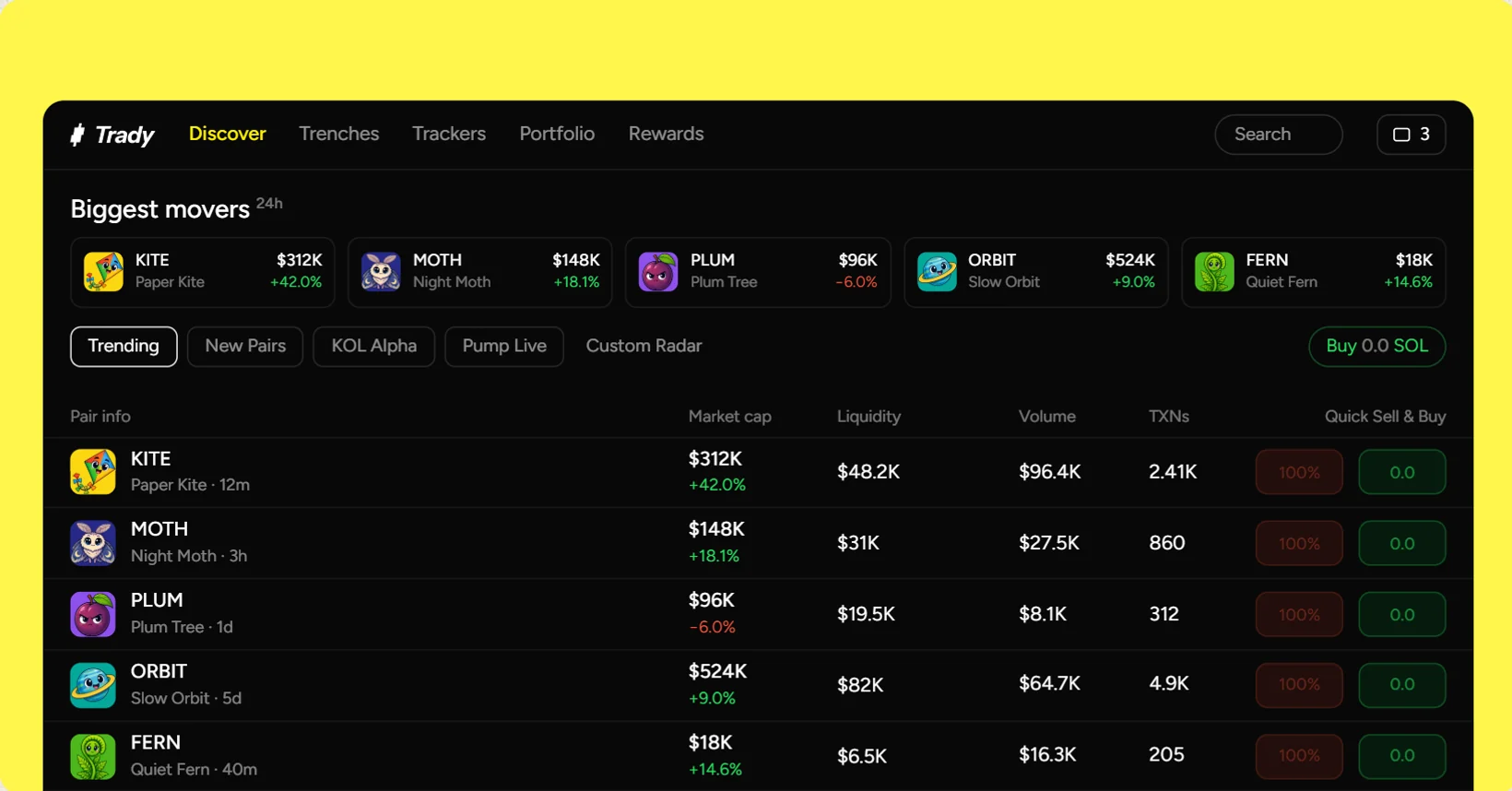
A cross-chain trading terminal where acting on a signal never means leaving the screen. Built from scratch, from sign-up to multi-wallet execution, for traders who have seconds to decide.
Overview
Meme coin traders deal with hundreds of new tokens an hour, with signals scattered across Telegram and X and only seconds to act. I designed Trady from scratch, from auth to signal filtering to multi-wallet execution, as the only designer on a team with 1 PM, 1 frontend and 1 backend developer, and 1 QA.
The problem
Existing tools showed everything and filtered nothing. Watching how traders worked, the pattern was constant jumping: the token list, a detail page, Telegram, X, then back to buy. In a market that moves in seconds, each jump can cost the trade.
So we set one constraint for the whole product: 10 seconds from discovering a token to buying it.
The approach
Keep the trade in the list
The familiar pattern is a detail page for every token. It’s the easiest to build, but it adds a step exactly where time runs out. A side panel keeps the list visible, but still takes a click and shrinks an already dense table.
I put actions and data directly in the list instead: Quick Buy & Sell in every row, token data inline, wallet and chain selectors fixed in the layout. The cost is density, and one-click buying makes mistakes easier, so the buy amount is set once and shown on the button, and secondary links stay in tooltips until hover.
Building it
Custom Radar
Every trader looks for something different, so Radar lets them set personal filters by chain, source, market cap and holder count, with AI-suggested presets based on past trading.
Nothing matches. Remove a filter to widen the radar.
KOL Alpha
Checking who was buying a token meant leaving the list. AI now tracks KOL wallets across chains in real time and shows who is accumulating as inline avatar stacks. It became the second most-used tab after Trending.
Multi-wallet settings
Power users split buys across wallets, which takes several settings that affect each other. Buy Variance, TX Delay, Auto-Cover Shortfall and Sell Deduction Order all live in a single modal, so they can be changed between trades.
What we cut
Three ideas were dropped to protect focus. A Social Feed pulled attention from the token list at the worst moment. Notifications would have needed a volume that overwhelmed people, and a wrong alert at 3am is worse than none. A full Portfolio Page turned out to be something traders didn’t want: they wanted to act, not reflect, so we shipped a balance widget in the dropdown instead.
Impact
In the first 6 weeks after launch we tracked DAU and session recordings, and interviewed 12 active traders.